Check out our reviews!
Real soundproofing. Not foam panels and prayer. We build acoustically-engineered wall and ceiling assemblies that stop noise cold—using SilentFX, Tech Sound, resilient bar systems, and premium materials that actually work.
Saanich is a noise laboratory. Traffic roars down McKenzie and Tillicum. UVic rental houses pulse with student life. Multi-generational families stack grandparents above nurseries. Basement suites share paper-thin walls with home theaters.
And most “soundproofing” installed in Saanich homes is complete garbage—Big Box insulation shoved in walls with no decoupling, single-layer drywall that transmits every conversation, and zero understanding of how sound actually travels through structures.
We do it differently. Every Finest Finish soundproofing assembly is engineered to achieve 70+ STC (Sound Transmission Class) ratings—the difference between “I can still hear them talking” and “I forgot anyone else lives here.”
This guide explains everything: how soundproofing actually works, what materials matter, why DIY fails, what it costs in Saanich, and how to get results that last decades.
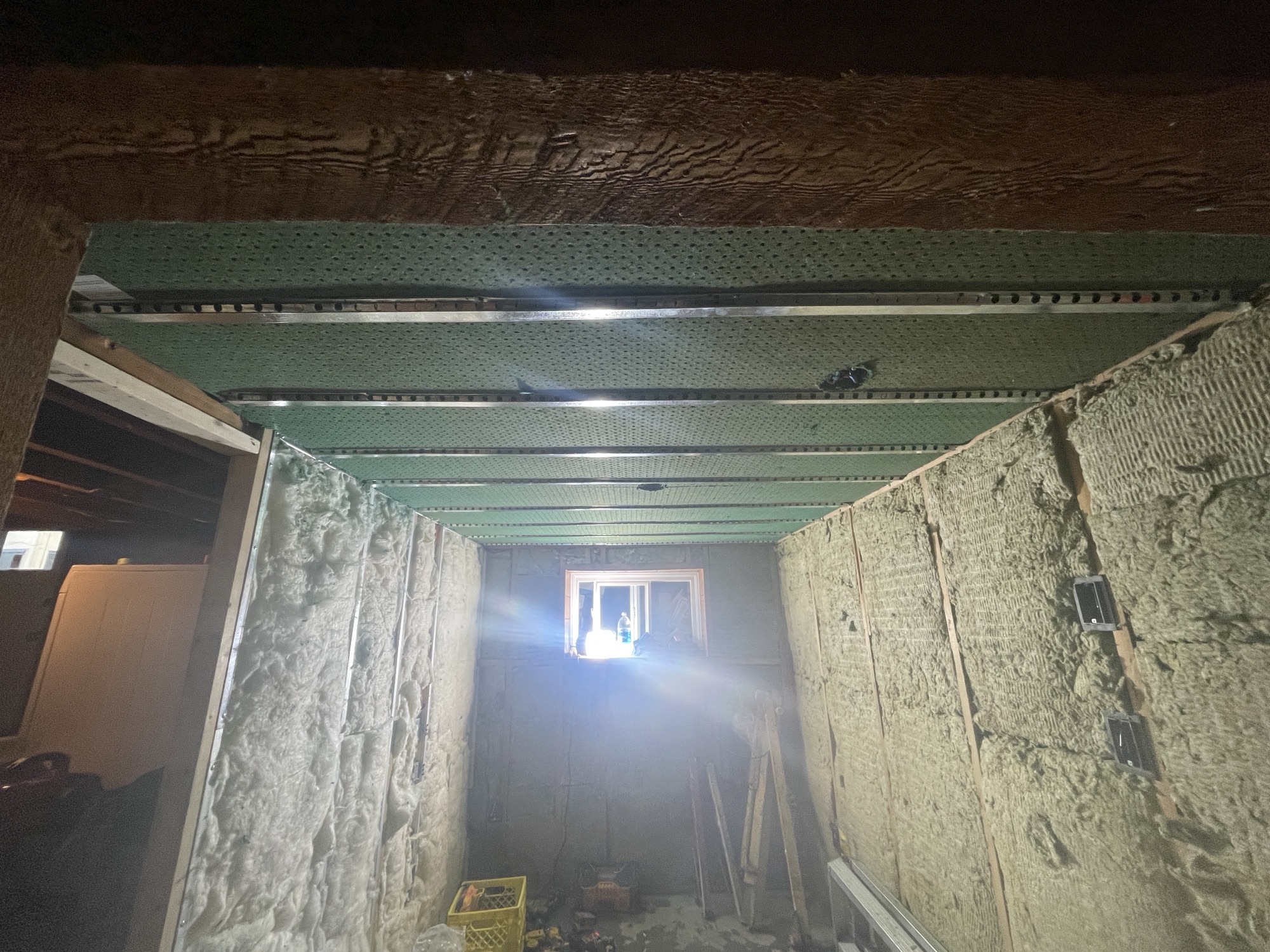
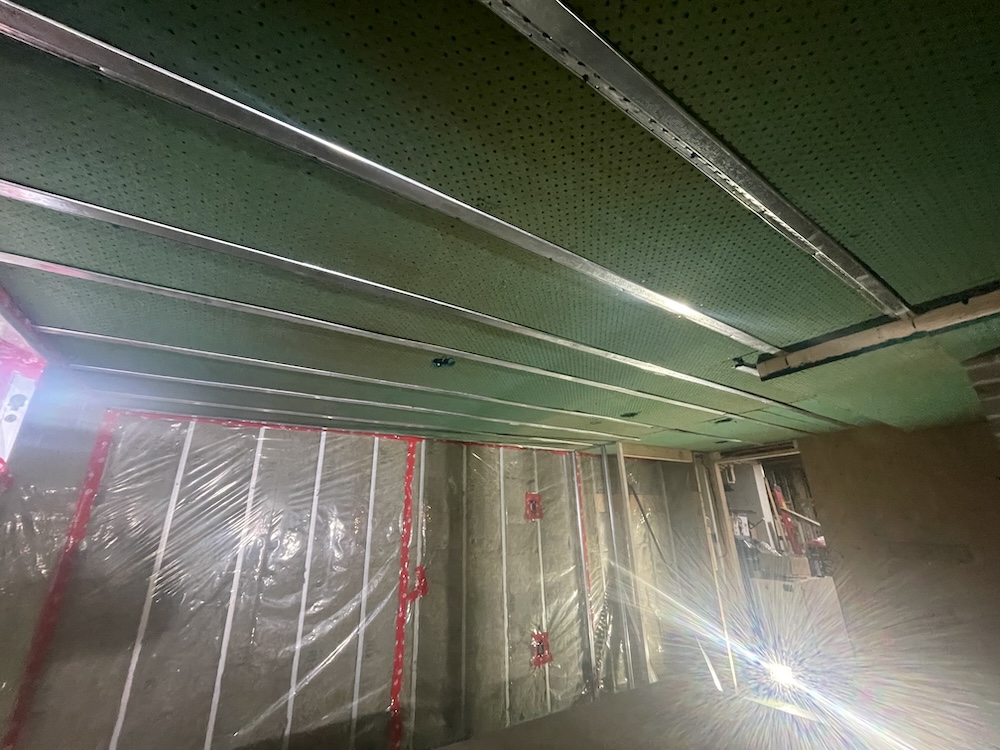

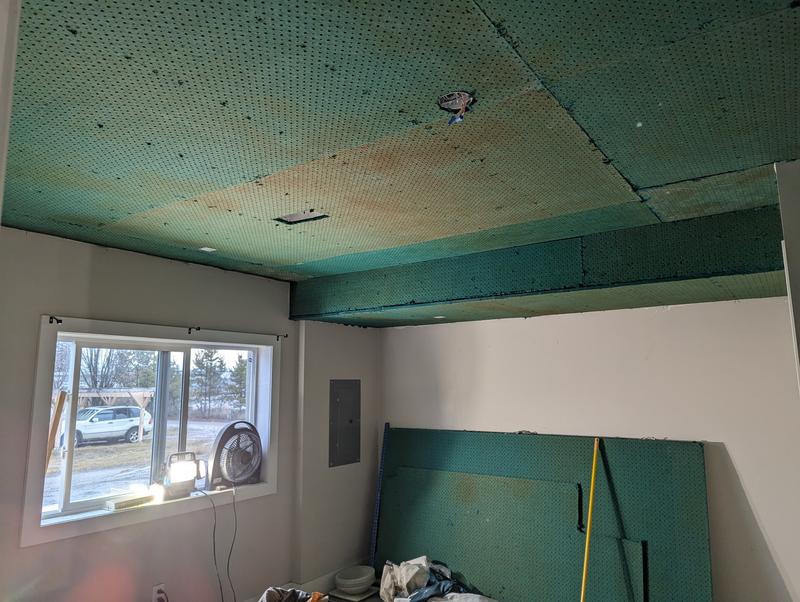
Why Soundproofing Saanich Homes Is Crucial for Quality of Life
Saanich isn’t one community—it’s a dozen microclimates of noise, each with unique acoustic challenges:
McKenzie Corridor & Major Arterials
Homes along McKenzie, Tillicum, Quadra, and Shelbourne face constant traffic noise:
Engines
Brakes
Emergency sirens
Delivery trucks at 6am
Sound penetrates through windows, walls, and any weak point in the building envelope.
Solution:
Dense mineral wool insulation
Decoupled drywall assemblies
Window upgrades
Traffic noise requires mass and air sealing—resilient channels alone won’t cut it.
UVic & Student Housing Areas (Cadboro Bay, Gordon Head)
Rental housing near campus deals with:
Party noise
Late-night conversations
Multiple tenants sharing walls
Property owners need soundproofing that protects tenant privacy and reduces neighbor complaints.
Solution:
Party wall soundproofing with full decoupling
Multi-layer drywall
Green Glue damping
STC 60–70 assemblies turn shared walls into actual acoustic barriers.
Multi-Generational Family Homes (Broadmead, Royal Oak)
Three generations under one roof often means:
Crying babies above home offices
Teenagers gaming late at night
Family rooms vibrating kitchen ceilings
Solution:
Ceiling soundproofing to isolate:
Impact noise (footsteps, furniture dragging)
Airborne sound (voices, TV)
Resilient bar systems decouple ceiling from floor joists, which is critical for footfall reduction.
Suite Conversions & Secondary Dwellings
Saanich’s housing market drives basement suite conversions. However, BC Building Code requires STC 50 minimum between suites. Smart homeowners typically aim for STC 60–70 for real privacy.
Solution:
Full suite separation
Acoustically isolated walls
Acoustically isolated ceilings
This ensures tenants renew leases and don’t complain about noise.
Heritage & Character Homes (Established Neighborhoods)
Older Saanich homes often feature:
Lath-and-plaster walls
Balloon framing
No acoustic design
Sound travels through wall cavities, ductwork, and ceiling voids like highways.
Solution:
Retrofit soundproofing that integrates modern acoustic assemblies with period construction.
Cheap contractors often damage heritage features when attempting resilient bar installations.
How Soundproofing Actually Works (And Why Cheap Methods Fail)
Sound is vibration. When someone talks, plays music, or walks across a floor, they create vibrations that travel through air (airborne sound) or through structure (impact sound).
To stop sound transmission, you need four acoustic principles working together:
1. Mass (Adding Weight to Block Sound)
Heavy materials block sound better than light materials. This is why:
- Two layers of 5/8″ drywall outperform one layer of 1/2″ drywall
- SilentFX (denser than standard drywall) blocks more sound per layer
- Concrete walls are quieter than wood-framed walls
Cheap method that fails: Adding single-layer drywall over existing walls. Adds minimal mass, minimal improvement.
2. Decoupling (Breaking the Vibration Path)
Sound travels through direct connections. If drywall screws directly into studs, vibrations transfer freely from one side of the wall to the other.
Decoupling systems (resilient bars, resilient channels, Tech Sound clips) create a break in the vibration path. The drywall “floats” on flexible connections instead of rigid screws.
This is the single most important factor in high-performance soundproofing. Without decoupling, you’re just adding expensive drywall that still transmits sound.
Cheap method that fails: Insulation without decoupling. Standard insulation in wall cavities helps, but without resilient mounting, sound still transmits through studs.
3. Absorption (Dissipating Sound Energy Inside Wall Cavities)
Dense, fibrous insulation inside wall cavities absorbs sound energy before it reaches the opposite wall surface. Not all insulation is equal:
- Roxul Safe’n’Sound (mineral wool): Designed specifically for acoustic absorption. Denser and more effective than fiberglass.
- Standard fiberglass insulation: Better than nothing, worse than mineral wool.
- Spray foam: Terrible for soundproofing. It’s rigid—conducts sound instead of absorbing it.
Cheap method that fails: Using leftover pink fiberglass or skipping insulation entirely. Sound bounces through empty cavities.
4. Damping (Converting Sound Vibrations to Heat)
Damping compounds (like Green Glue) are applied between drywall layers. When sound vibrations hit the wall, the damping layer converts vibration energy into tiny amounts of heat—reducing transmission.
Green Glue significantly boosts STC ratings—typically adding 5-9 STC points compared to the same assembly without it.
Cheap method that fails: Skipping damping compound to save $200. Results in mediocre performance and disappointed homeowners.
Understanding STC Ratings: What 70+ STC Actually Means
STC (Sound Transmission Class) is the standard measurement for how much sound a wall or ceiling blocks. Generally speaking, higher numbers = better soundproofing.
STC Rating Guide
- STC 25-30: Normal speech easily understood through wall. Offers virtually no privacy.
- STC 35-40: Loud speech understood, normal speech heard but not clearly understood. Typical of cheap apartment walls.
- STC 45-50: Loud speech heard but not understood, normal speech barely audible. Minimum code requirement for suites in BC.
- STC 55-60: Loud speech faintly heard, normal speech not heard. Good privacy for most residential applications.
- STC 65-70: Very loud sounds (shouting, music) faintly heard, normal conversation inaudible. Excellent soundproofing.
- STC 70+: Most sounds inaudible. High-performance acoustic isolation. This is what Finest Finish builds.
BC Building Code Requirements
BC Building Code requires minimum STC 50 for walls and floor/ceiling assemblies separating dwelling units (suites).
But here’s the problem: STC 50 is barely adequate. You’ll still hear loud TV, music, arguments, and footsteps. It’s a legal minimum, not a comfort standard.
Smart homeowners aim for STC 60-70+—the difference between “I can hear my tenants” and “I forget they’re there.”
Why Standard Construction Fails Acoustically
Typical wood-framed wall with fiberglass insulation and single-layer drywall: STC 33-39. Completely inadequate for privacy.
Adding a second drywall layer with no other changes: STC 43-47. Better, but still not enough.
To hit 70+ STC requires:
- Decoupled assemblies (resilient bars or clips)
- Dense acoustic insulation (Roxul Safe’n’Sound)
- Multi-layer drywall (often SilentFX or double 5/8″ layers)
- Damping compound between layers (Green Glue)
- Complete air sealing (acoustic caulking at every penetration)
Soundproofing Materials We Use (And Why They Matter)
Every material in a soundproofing assembly serves a specific acoustic function. Here’s what we use and why:
SilentFX Drywall
What it is: Fiberglass-reinforced gypsum board. Denser and more acoustically effective than standard drywall.
Why we use it: Higher mass per square foot = better sound blocking. Also more flexible (resists cracking from vibration). Commonly used as the first layer in high-performance assemblies.
STC boost: 3-5 points higher than standard drywall in equivalent assemblies.
Tech Sound Panels
What it is: High-density acoustic gypsum panels designed specifically for soundproofing applications.
Why we use it: Combines mass with acoustic damping properties. Often used in ceiling assemblies where weight and performance both matter.
Best applications: Ceiling soundproofing, walls requiring maximum STC in minimal thickness.
Resilient Bar Systems (Resilient Channel)
What it is: Metal channels that attach to studs or joists, creating a flexible mounting system for drywall. The drywall screws into the resilient bar—NOT directly into framing.
Why we use it: Decoupling. This breaks the vibration path between wall surfaces. Without resilient mounting, sound transmits directly through studs.
STC boost: 10-15 points compared to direct-mounted drywall. This is the single biggest performance upgrade.
Installation critical: Resilient bars must be installed correctly (perpendicular to framing, proper spacing, no rigid connections). Amateur installation often defeats the decoupling—we see this constantly in failed DIY soundproofing.
What it is: Viscoelastic damping compound applied between drywall layers. Stays flexible permanently (doesn’t harden like adhesive).
Why we use it: Converts sound vibration energy into trace amounts of heat. Works across the entire frequency spectrum—effective for voices, music, bass, and impact noise.
STC boost: 5-9 points when used between drywall layers. One of the most cost-effective performance upgrades.
Application: Applied in random squiggly pattern across drywall surface before installing second layer. Requires proper coverage—skimping on Green Glue reduces performance.
Green Glue Damping Compound
What it is: Viscoelastic damping compound applied between drywall layers. Stays flexible permanently (doesn’t harden like adhesive).
Why we use it: Converts sound vibration energy into trace amounts of heat. Works across the entire frequency spectrum—effective for voices, music, bass, and impact noise.
STC boost: 5-9 points when used between drywall layers. One of the most cost-effective performance upgrades.
Application: Applied in random squiggly pattern across drywall surface before installing second layer. Requires proper coverage—skimping on Green Glue reduces performance.
Roxul Safe'n'Sound (Mineral Wool Insulation)
What it is: High-density mineral wool insulation specifically designed for acoustic applications. Denser and more fire-resistant than fiberglass.
Why we use it: Absorbs sound energy within wall cavities. The fibrous structure traps sound waves and prevents echo within the cavity.
STC boost: 5-8 points compared to empty wall cavities. Essential for high-performance assemblies.
Not a substitute for decoupling: Roxul helps, but without resilient mounting, sound still transmits through framing. Both are necessary.
What it is: Engineered wood fiber panels with acoustic properties. Often used as a base layer under drywall.
Why we use it: Adds mass and damping in a single product. Particularly useful in retrofit situations where space is limited.
Best applications: Ceiling soundproofing, thin wall assemblies, heritage home retrofits.
Acoustic Caulking & Sealants
What it is: Flexible acoustic sealant that remains permanently elastic. Applied at all wall/ceiling penetrations, electrical boxes, perimeter gaps.
Why we use it: Sound travels through air gaps like water through cracks. Even a 1% gap in wall coverage can reduce STC rating by 50%. Complete air sealing is non-negotiable.
Common failure point: Contractors skip acoustic caulking to save time. Results in expensive soundproofing that still leaks sound.
Soundproofing Assembly Types: What We Build in Saanich
Every soundproofing project gets a custom-engineered assembly based on noise source, target STC, and existing construction. Here are our most common configurations:
Standard High-Performance Wall Assembly (STC 65-70)
Layer stack (from one side of wall to other):
- Existing stud wall (2×4 or 2×6 framing)
- Roxul Safe’n’Sound mineral wool insulation (fills cavity completely)
- Resilient bar or channel system (attached to one or both sides of studs)
- 5/8″ SilentFX or Type X drywall (first layer, screwed to resilient bars only)
- Green Glue damping compound (full coverage between layers)
- 5/8″ standard drywall (second layer)
- Acoustic caulking at all perimeters, penetrations, electrical boxes
- Finish: Level 4 or 5 drywall finish, paint-ready
Performance: STC 65-70. Blocks normal conversation completely, significantly reduces loud TV/music, excellent for bedrooms and suite separations.
Thickness added: Approximately 2.5-3″ per side (if treating both sides of wall).
Premium Wall Assembly (STC 70-75+)
Upgrades from standard assembly:
- Staggered-stud or double-stud wall construction (complete structural decoupling)
- Dense-pack mineral wool or double-layer insulation
- SilentFX or Tech Sound on both drywall layers
- Triple-layer drywall with Green Glue between each layer
Performance: STC 70-75+. Near-total acoustic isolation. Appropriate for recording studios, home theaters, or situations requiring maximum privacy.
Cost: 40-60% higher than standard assembly due to additional materials and labor.
Ceiling Soundproofing Assembly (STC 65-70)
Layer stack:
- Existing floor joists with subfloor above
- Roxul Safe’n’Sound between joists (from below)
- Resilient bar system attached perpendicular to joists
- 5/8″ SilentFX or Type X drywall (first layer)
- Green Glue damping compound
- 5/8″ standard drywall (second layer)
- Acoustic caulking at perimeter and all penetrations
Performance: STC 65-70 for airborne sound. Significantly reduces footfall and impact noise (though floor-side treatment is more effective for impact noise).
Critical detail: Resilient bars must not touch joists at any rigid connection point. Bridging defeats decoupling.
Retrofit Soundproofing (Existing Wall Enhancement)
When demolition isn’t an option, we can add soundproofing to existing walls:
- Assess existing wall construction and identify weak points
- Add resilient bar system over existing drywall
- Install additional drywall layer(s) with Green Glue
- Acoustic caulking at all new perimeter connections
Performance: STC improvement of 10-15 points depending on existing construction. Not as effective as full build-out (can’t add insulation without opening walls), but substantial improvement for moderate cost.
Best for: Homeowners who want better soundproofing without major renovation disruption.
What Professional Soundproofing Costs in Saanich
Soundproofing costs are impossible to quote without assessing the specific project. Here’s why pricing varies—and what to expect:
Why Soundproofing Costs Vary So Much
1. Wall/Ceiling Area: Measured in linear feet (walls) or square feet (ceilings). Larger rooms = higher cost.
2. Target STC Rating: STC 60 assemblies cost less than STC 70+ assemblies. More layers = more material + more labor.
3. Access & Height: Standard 8′ ceilings are straightforward. Vaulted ceilings, stairwells, or difficult access increases labor cost.
4. Existing Construction: New construction is cleanest. Retrofit work (opening walls, dealing with electrical/plumbing, preserving finishes) adds complexity.
5. Number of Penetrations: Electrical outlets, light switches, HVAC vents, recessed lights—each penetration requires acoustic sealing. More penetrations = more labor.
6. Material Selection: Standard assemblies (resilient bar + Roxul + double drywall + Green Glue) cost less than premium assemblies (staggered studs + SilentFX + triple layers + Tech Sound).
Ballpark Cost Ranges for Saanich Projects
MINIMUM PROJECT COST: $3,500
This covers small-scope soundproofing (single wall, small room) with professional assessment, materials, skilled installation, and quality finish.
Per-Room Soundproofing:
- Small bedroom (one or two walls): $4,000-$7,000
- Medium room (three walls + ceiling): $8,000-$14,000
- Large room or open space: $12,000-$20,000+
Wall Soundproofing (per linear foot of wall):
- Standard assembly (STC 60-65): Varies based on height and configuration
- Premium assembly (STC 70+): Significantly higher due to additional layers and materials
Ceiling Soundproofing:
- Standard assembly: Quoted per square foot based on ceiling area and joist access
- High ceilings or vaulted: Higher cost due to scaffolding and access requirements
Full Suite Separation (walls + ceiling):
- Small suite (500-700 sq ft): $12,000-$20,000
- Medium suite (700-1000 sq ft): $18,000-$30,000
- Large or complex suite: $25,000-$45,000+
Suite pricing depends heavily on:
- Number of shared walls and ceilings requiring treatment
- Existing construction condition
- Electrical and plumbing modifications needed
- Target STC rating (code minimum STC 50 vs premium STC 65-70)
What's Included in Finest Finish Soundproofing Projects
- Professional acoustic assessment: We evaluate noise sources, existing construction, and recommend appropriate assembly types
- All materials: Resilient bars, insulation, drywall, Green Glue, acoustic caulking, fasteners
- Skilled installation: Proper decoupling technique, complete air sealing, precise drywall finishing
- Level 4 or 5 finish: Paint-ready surface that integrates seamlessly with existing walls
- Dust control: Plastic masking, negative air systems, daily cleanup
- Job site protection: Floor covering, furniture protection, minimal disruption
- Warranty: Workmanship and materials warranty explained upfront
Why DIY Soundproofing Usually Fails (And Costs More Long-Term)
YouTube makes soundproofing look easy. It’s not. Here’s where DIYers fail:
Mistake #1: Skipping Decoupling
Adding mass (extra drywall, dense insulation) without decoupling (resilient bars) delivers mediocre results. You’ll get maybe 5-8 STC improvement instead of 20-25 STC.
Mistake #2: Improper Resilient Bar Installation
Resilient bars MUST float—no rigid connections to framing. DIYers constantly over-screw, bridge connections, or install perpendicular to correct orientation. This defeats decoupling entirely.
Mistake #3: Incomplete Air Sealing
Sound leaks through air gaps. Every electrical box, light switch, perimeter gap, and penetration needs acoustic caulking. Miss 5% of sealing and you lose 50% of soundproofing performance.
Mistake #4: Wrong Materials
Standard fiberglass insulation instead of Roxul Safe’n’Sound. Construction adhesive instead of Green Glue. Regular caulking instead of acoustic sealant. These substitutions kill performance.
Mistake #5: Unrealistic Expectations
Adding egg crate foam or mass-loaded vinyl over existing drywall delivers minimal improvement. Real soundproofing requires invasive construction—opening walls, building proper assemblies, dealing with electrical.
The Result: You spend $2,000-$4,000 on materials and 40 hours of labor for STC 45-50 performance. Then you hire us to rip it out and do it right—total cost 2x what it would have cost to hire professionals initially.
What Professional Soundproofing Costs in Saanich
Saanich’s housing market makes basement suites financially attractive. But poorly-soundproofed suites create miserable living conditions for everyone involved.
BC Building Code Requirements for Suite Separation
BC Building Code mandates minimum STC 40 for walls and floor/ceiling assemblies separating dwelling units.
This applies to:
- Walls between suite and main dwelling
- Ceiling/floor assembly between suite and main dwelling
- Walls between separate rental units (if multiple suites)
Code compliance isn’t optional. Building inspectors test assemblies. Failed soundproofing means no occupancy permit.
Why Smart Landlords Exceed Code Minimums
STC 50 is barely adequate. You’ll hear:
- Loud TV and music clearly
- Raised voices and arguments
- Footsteps and furniture movement
- Shower/toilet noise
This creates:
- Tenant complaints: “I can hear everything upstairs”
- Shorter tenancies: Good tenants leave for quieter units
- Vacancy issues: Word spreads that your suite has noise problems
- Reduced rental income: Noisy suites command lower rents
Investing in STC 60-70 assemblies pays for itself:
- Longer tenant retention (lower turnover costs)
- Higher rental rates (premium for quiet suites)
- Fewer complaints and conflicts
- Protects property value and marketability
Common Suite Soundproofing Challenges
Challenge #1: Shared HVAC Systems
Ductwork transmits sound between units. Solution: Acoustic duct lining or separate HVAC systems.
Challenge #2: Plumbing Noise
Drain stacks, water pipes, and toilets create noise. Solution: Acoustic pipe wrapping and isolated plumbing chases.
Challenge #3: Electrical Penetrations
Back-to-back electrical boxes create sound leaks. Solution: Staggered boxes with acoustic putty pads.
Challenge #4: Footfall Noise
Ceiling soundproofing helps, but floor treatment (carpet, underlayment) on upper level is more effective. Solution: Combination approach—resilient ceiling below plus soft flooring above.
Suite Soundproofing Investment vs Return
Let’s say you’re converting a basement suite. Two scenarios:
Scenario A: Cheap Soundproofing (Code Minimum STC 50)
- Cost: $8,000-$12,000
- Rental rate: $1,400/month (market average for adequate-but-noisy suite)
- Tenant retention: 12-18 months average
- Annual turnover cost: $2,000 (vacancy + advertising + cleaning)
Scenario B: Premium Soundproofing (STC 65-70)
- Cost: $15,000-$22,000 (additional $7,000-$10,000 investment)
- Rental rate: $1,600/month (premium for quiet, quality suite)
- Tenant retention: 24-36 months average
- Annual turnover cost: $800 (less frequent turnover)
Financial difference over 5 years:
- Additional rental income: $12,000 ($200/month x 60 months)
- Reduced turnover costs: $6,000
- Total benefit: $18,000
- Additional investment: $7,000-$10,000
- Net return: $8,000-$11,000 over 5 years
Premium soundproofing pays for itself—while delivering better tenant satisfaction and protecting your sanity.
Soundproofing Heritage Homes in Saanich: Unique Challenges & Solutions
Saanich’s established neighborhoods feature dozens of heritage and character homes (pre-1950s construction). These homes present unique soundproofing challenges:
Lath-and-Plaster Walls
The challenge: Original walls use wood lath strips with plaster coating—not modern drywall. Lath-and-plaster is fragile, difficult to work with, and often damaged during renovation.
Our solution: We specialize in retrofitting soundproofing into heritage homes without destroying original plaster. Methods include:
- Furring out from existing plaster to create decoupled cavity
- Building new stud walls with air gap from original walls
- Careful removal and preservation of plaster in select areas
- Acoustic treatments that respect heritage character
Balloon Framing and Open Wall Cavities
The challenge: Many heritage homes use balloon framing—studs run continuously from foundation to roof with no fire blocking between floors. This creates acoustic highways where sound travels vertically through wall cavities.
Our solution: Strategic fire blocking and cavity sealing to compartmentalize sound transmission paths. Requires working within walls without major structural changes.
Settling and Uneven Framing
The challenge: 70-100 year old homes have settled. Walls aren’t plumb, floors aren’t level, ceiling heights vary. Standard soundproofing assemblies assume square, level surfaces.
Our solution: Custom shimming, flexible mounting systems, and acoustic assemblies that accommodate out-of-square conditions. Requires experience—amateur installers create gaps that leak sound.
Preserving Character Features
The challenge: Heritage homes have crown molding, picture rails, wainscoting, and period details that homeowners want to preserve.
Our solution: Careful removal, protection, and reinstallation of heritage features. We treat your home’s character elements as valuable assets, not obstacles.
Frequently Asked Questions About Soundproofing in Saanich BC
How much does soundproofing cost in Saanich BC?
Professional soundproofing in Saanich starts at a $3,500 minimum. Per-room costs vary significantly based on wall area, ceiling height, existing construction, and target STC rating. Full suite separations can range from $8,000-$25,000+ depending on scope. Every project requires a custom assessment due to the complexity of acoustic engineering.
What STC rating do Finest Finish soundproofing assemblies achieve?
Our soundproofing assemblies achieve 70+ STC (Sound Transmission Class) ratings using professional-grade materials including SilentFX, Tech Sound, resilient bar systems, Green Glue, and Roxul Safe’n’Sound insulation. This level of performance dramatically reduces voice transmission, TV noise, music, and footfall noise.
Can you soundproof rental suites in Saanich?
Yes. Suite soundproofing is one of our core specialties in Saanich. We build acoustically-isolated partitions between suites and main living areas, addressing both airborne sound (voices, TV, music) and impact sound (footsteps, furniture movement). This improves privacy and comfort for both homeowners and tenants.
What materials do you use for soundproofing?
We use premium acoustic materials including SilentFX drywall (fiberglass-reinforced gypsum), Tech Sound panels, resilient bar or channel systems for vibration isolation, Green Glue damping compound, Roxul Safe’n’Sound mineral wool insulation, SONOpan acoustic panels, and acoustic caulking for air sealing. Each material serves a specific acoustic function.
How long does soundproofing installation take?
Most soundproofing projects in Saanich take 8-14 days depending on scope. Single room soundproofing may complete in 3-5 days, while full suite separation with multiple walls and ceilings takes 10-14 days. Timeline depends on drying requirements, number of assembly layers, and finish level.
Does soundproofing work for ceiling noise and footsteps?
Yes. Ceiling soundproofing addresses both airborne sound (voices, TV) and impact sound (footsteps, furniture dragging). We use resilient bar systems to decouple the ceiling from floor joists, dense insulation to absorb sound, and multi-layer drywall assemblies to block transmission. This dramatically reduces noise transfer from upper floors.
Will soundproofing reduce room size?
Yes, by approximately 2-4 inches per wall depending on assembly type. A standard soundproofing assembly adds about 2.5 inches to wall thickness. While this reduces room dimensions slightly, the acoustic performance gain is substantial. We discuss space impact during initial assessment.
Can you soundproof heritage homes in Saanich?
Absolutely. Saanich has many heritage and character homes with lath-and-plaster walls. We specialize in integrating modern soundproofing systems into older construction without damaging original features. This requires experience with period construction methods and careful transition detailing.
Does soundproofing help with traffic noise from McKenzie or Tillicum?
Yes, but exterior soundproofing requires a different approach than interior walls. For traffic noise, we focus on exterior-
Call Today for Professional Soundproofing in Saanich
Or request a callback below. We’ll deliver a clear, transparent plan so you know exactly what to expect.