Basement Soundproofing: The 2026 Guide to a Quiet, High-Value Victoria Home
In the modern Victoria, BC real estate landscape, the basement has evolved. Following the implementation of Bill 44, homeowners across the Greater Victoria Area—from Oak Bay to Langford—are increasingly converting underutilized spaces into high-end secondary suites, executive home offices, and immersive home theaters. However, a common hurdle remains: the structural transmission of noise.
At Finest Finish, we know that high-quality drywall installation is only half the battle. To create a truly comfortable environment, you must master the science of acoustics. Whether you are dealing with airborne noise (talking, music) or impact noise (footsteps, dropped objects), professional soundproofing is an investment that pays dividends in both property value and quality of life.
The 4 Pillars of Acoustic Engineering
To understand why a single layer of standard gypsum board fails to block sound, we must look at the four mechanical ways sound travels through a home. At Finest Finish, our renovation strategy is built on these four pillars:
1. Mass
Sound waves are physical energy. To stop them, you need density. High-mass materials like SilentFX QuickCut, Type X drywall, and Mass Loaded Vinyl (MLV) make it difficult for sound waves to vibrate the surface of your walls.
2. Damping
Damping involves the use of a viscoelastic polymer, such as Green Glue Noiseproofing Compound. When sound hits a wall, the damping layer converts the kinetic energy of the vibration into trace amounts of heat, effectively “eating” the sound before it reaches the other side.
3. Decoupling
This is the most critical step for basement suites. Decoupling breaks the physical connection between the ceiling and the floor joists above. By using resilient channels or RSIC-1 clips, we create a “floating” ceiling that prevents impact noise from traveling through the timber frame of the house.
4. Absorption
The air cavity between your studs acts like a drum, amplifying sound. We fill these voids with specialized acoustic insulation, such as Roxul Safe’n’Sound or Quiet Batt mineral wool, which absorbs echoes and prevents the “echo chamber” effect.
Product Spotlight: The 2026 Industry Standards
To achieve professional-grade results, Finest Finish utilizes a curated selection of advanced materials that go far beyond what you find in a standard hardware aisle.
SilentFX® QuickCut™ by CertainTeed
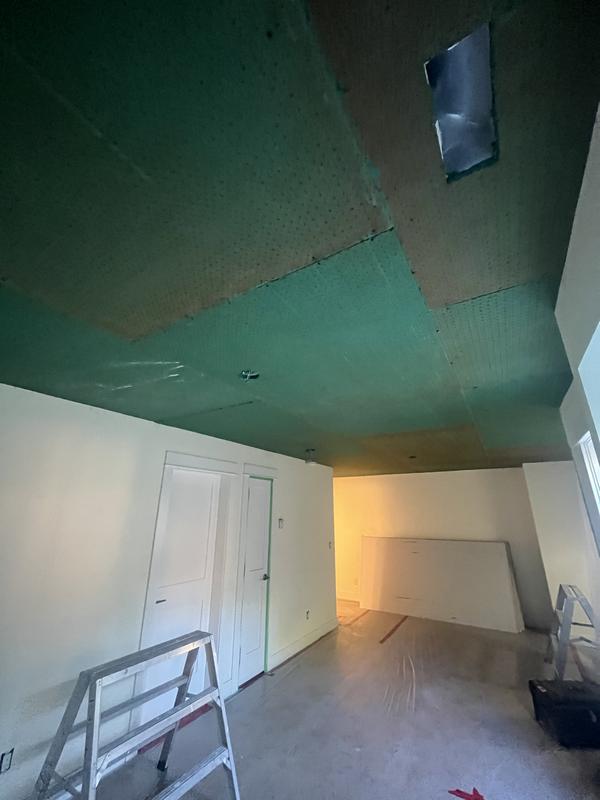
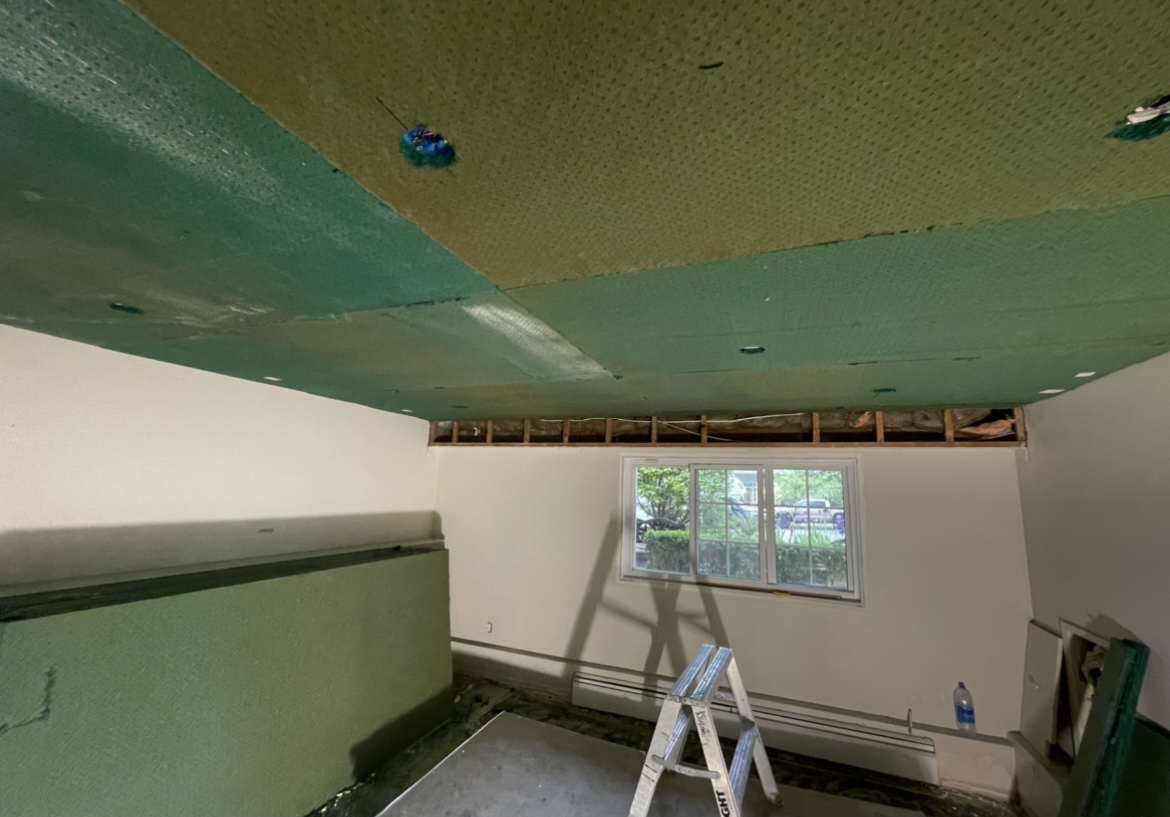
SilentFX is a game-changer for drywall contractors. This noise-reducing gypsum panel features a factory-applied viscoelastic polymer between two dense cores. It allows us to achieve an STC rating (Sound Transmission Class) of 50 or higher in a single layer. Not only is it highly effective at blocking sound, but it also features M2Tech® technology, making it resistant to mold and moisture—a necessity for Vancouver Island basements.
SONOpan and SONOpanX
A Canadian staple, SONOpan panels are made from 100% recycled wood. These 4’x8′ panels are lightweight and feature thousands of impressions of varying depths on both sides, which trap sound waves across the frequency spectrum. SONOpanX is specifically designed for floors, providing an excellent IIC (Impact Insulation Class) rating for those living above a rental suite.
The Finest Finish Installation Process
Successful soundproofing is about precision. Even a 1% gap in your assembly can result in a 50% reduction in acoustic performance. This is known as flanking noise.
The Framing and Cavity Phase
We begin by inspecting the framing. For maximum isolation, staggered stud or double stud walls are ideal. We then install mineral wool insulation tightly between the studs, ensuring no gaps are left around electrical boxes or plumbing stacks.
The Decoupling Stage
For ceilings, we install resilient channels perpendicular to the joists. Our technicians are trained to avoid “short-circuiting” the system—a common DIY mistake where a screw is driven through the channel and into the joist, reconnecting the path for sound to travel.
The Finest Finish Installation Process
Successful soundproofing is about precision. Even a 1% gap in your assembly can result in a 50% reduction in acoustic performance. This is known as flanking noise.
The Framing and Cavity Phase
We begin by inspecting the framing. For maximum isolation, staggered stud or double stud walls are ideal. We then install mineral wool insulation tightly between the studs, ensuring no gaps are left around electrical boxes or plumbing stacks.
The Decoupling Stage
For ceilings, we install resilient channels perpendicular to the joists. Our technicians are trained to avoid “short-circuiting” the system—a common DIY mistake where a screw is driven through the channel and into the joist, reconnecting the path for sound to travel.
Soundproofing for Legal Suites in Victoria
The BC Building Code has strict requirements for fire separation and sound transmission between dwellings. To legalize a basement suite in municipalities like Saanich or Esquimalt, you must meet specific STC ratings.
Investing in professional soundproofing doesn’t just pass inspection—it ensures tenant retention. In a city with high rental demand, a “quiet suite” is a premium feature that allows homeowners to command higher monthly rents while avoiding noise complaints and disputes.
Room-Specific Acoustic Strategies
Home Theaters: We focus on low-frequency damping to handle the heavy bass of subwoofers. This often requires triple-layer drywall and specialized bass traps.
Home Offices: Privacy is key. We focus on airborne noise reduction to ensure your Zoom calls aren’t interrupted by the hum of the dishwasher upstairs.
Mechanical Rooms: We wrap HVAC ducts with Quiet Wrap™ and use MLV on doors to contain the noise of furnaces and heat pumps.
Frequently Asked Questions (FAQ)
1. Can I soundproof my basement without removing the existing ceiling?
Yes, we can apply a “retrofit” solution by adding a layer of SONOpan or SilentFX over your current drywall using damping compound. However, for maximum results, removing the old ceiling to install insulation and resilient channels is recommended.
2. What is the difference between SONOpan and SilentFX?
SONOpan is an eco-friendly wood fiber panel that is installed behind the drywall to absorb sound. SilentFX is a specialized, high-density drywall that has soundproofing technology built into the board itself. Using them together provides world-class isolation.
3. How much does basement soundproofing cost in Victoria?
Costs vary based on the level of isolation required. A basic upgrade with mineral wool and 5/8″ drywall is more affordable, while a high-performance “room-within-a-room” theater setup requires a larger investment. Contact Finest Finish for a detailed quote.
4. Does soundproofing also help with heat insulation?
Absolutely. The high-density mineral wool we use for acoustics (like Safe’n’Sound) also provides excellent thermal properties, keeping your basement warmer in the winter and cooler in the summer.
5. Is it possible to completely block all noise?
While “soundproof” is the common term, “sound isolation” is more accurate. We can reduce noise to the point where it is no longer audible or disruptive, but blocking 100% of vibrations (like a nearby earthquake or heavy construction) is nearly impossible in residential frames.
Conclusion: Invest in Silence with Finest Finish
Your home is your sanctuary. Don’t let the noise of a busy household or a rental suite compromise your peace of mind. As Victoria’s experts in acoustic drywall installation, Finest Finish has the tools, the technology (like SilentFX and SONOpan), and the expertise to transform your basement.
Ready to start your project? Contact Finest Finish today for a professional acoustic consultation.