Why Large Homes Demand Professional Drywall Installation: Beyond the Basics of Modern Luxury
When you step into a sprawling custom estate in Oak Bay or a contemporary architectural marvel in the Uplands, your eyes don’t immediately land on the drywall. You notice the sweeping views of the Salish Sea, the custom millwork, the Italian marble countertops, or the way the sunlight pours through floor-to-ceiling windows. But here is the industry secret: none of those high-end features look good if the “canvas”—the drywall—isn’t perfect.
In a small condo or a standard starter home, a minor hump in a wall or a slightly visible seam might hide behind a bookshelf. In a 5,000-square-foot luxury home, there is nowhere to hide. Large homes present unique physical, structural, and aesthetic challenges that make DIY efforts or budget-rate contractors a recipe for financial disaster. If you are building or renovating a significant property in Victoria, BC, understanding why professional drywall installation is a non-negotiable investment is the first step toward a flawless interior. For residents seeking the highest standard of care, our team specializes in Drywall Installation & Repair in Victoria BC, ensuring that your walls are as sturdy as they are beautiful.
The Engineering Challenge: Scale and Structural Movement
A large home isn’t just a bigger version of a small home; it’s a more complex living organism. From a construction standpoint, the sheer volume of wood or steel framing involved means that structural settling and wood shrinkage are amplified across the structural integrity of the build.
1. Managing the “Breathe” of a Mansion
Every new build goes through a period of “drying out.” In a large residential drywall project, the cumulative effect of hundreds of studs shrinking can cause significant stress on the gypsum board. Professional installers understand the physics of the substrate bonding. We don’t just slap up sheetrock; we strategically place expansion joints—vital structural elements designed to allow normal movement—and use specific fastening patterns and drywall screws to ensure that when the house settles, the walls don’t crack.
Without this expertise, homeowners often see hairline cracks appearing at the corners of doors or across vast ceiling spans within the first year. These aren’t just eyesores; they are signs that the drywall was fighting the house’s natural movement—and losing.
2. High Ceilings and Vaulted Spaces
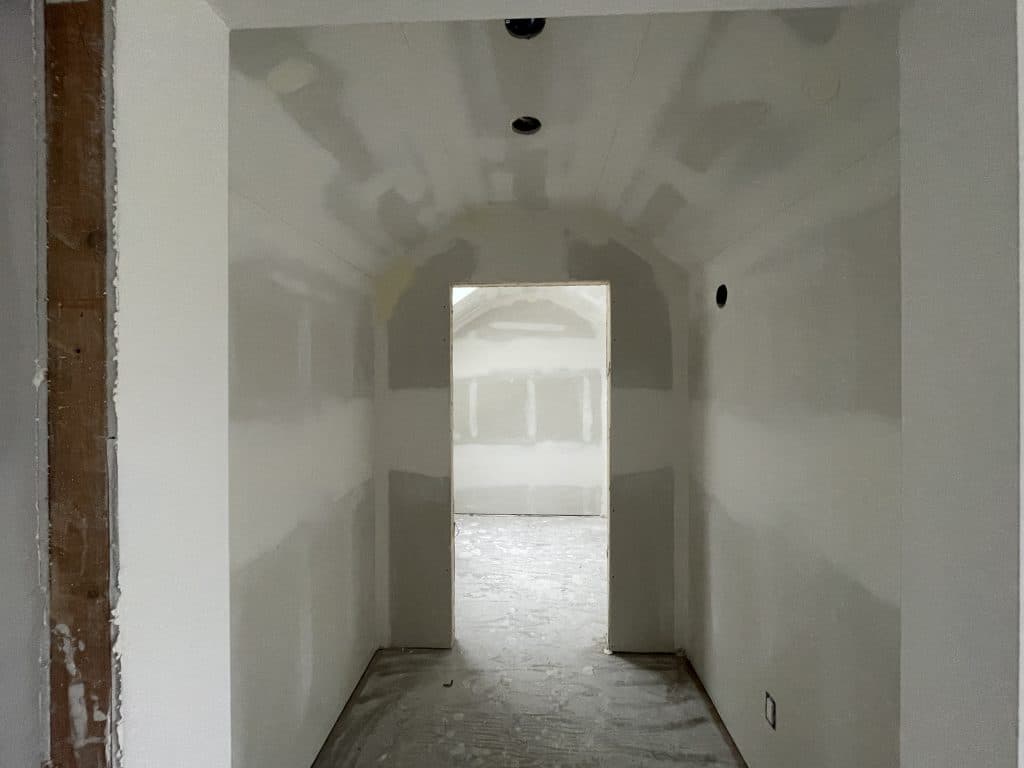
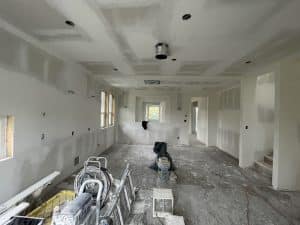
Large homes often feature vaulted ceilings, coffered ceilings, or tray ceilings that add drama to a grand foyer or master suite. Hanging heavy 5/8-inch Type X drywall on a 20-foot ceiling is not only dangerous for an amateur; it requires specialized equipment like heavy-duty drywall lifts and scaffolding. Beyond the safety aspect, the taping and finishing on a high ceiling is visible from multiple angles and under varying light conditions throughout the day. If the butt joints and factory edges aren’t feathered out perfectly with the right taping knives, you will see a “hump” every time the sun sets.
The Enemy of the Amateur: Critical Lighting
In luxury architectural design, natural light is a primary feature. Large windows and open-concept floor plans allow light to “graze” across the walls. In the industry, we call this critical lighting or grazing light.
The Level 5 Finish Standard
For most standard homes, a “Level 4 finish” is the norm. This involves taping, three coats of joint compound, and sanding. However, in a large home with recessed lighting or high-gloss paint, Level 4 isn’t enough. According to the Gypsum Association’s GA-214 standards, a Level 5 finish is essential for areas with critical lighting.
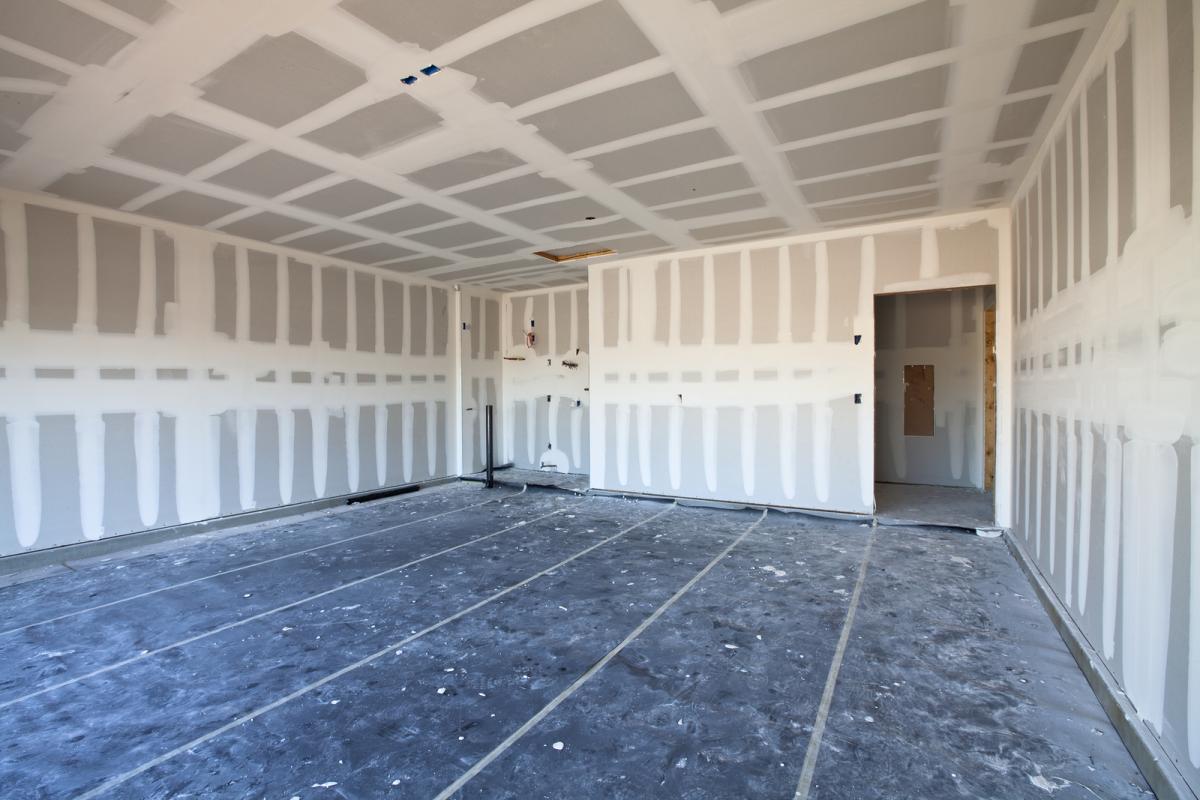
This involves a final skim coat—a thin layer of finishing mud applied over the entire surface of the wall, not just the seams. This creates a uniform surface chemistry and porosity. Without a Level 5 finish, the paint will soak into the paper of the drywall differently than it soaks into the taping mud. This leads to “flashing” or “ghosting,” where you can see exactly where every seam is, even under three coats of premium paint.
Acoustics and the “Echo Chamber” Effect
One of the most common complaints in modern, large-scale renovations is noise. Open-concept living is beautiful, but without professional soundproofing integrated into the drywall phase, your home can sound like a gymnasium. We look at the “acoustic blueprint” of the home to manage acoustics effectively.
- Home Theaters & Media Rooms: We utilize sound-dampening drywall (like QuietRock) and Green Glue damping compound between layers to decouple the vibration of sound waves.
- Master Suites: To ensure privacy, we install resilient channels or sound attenuation batts within the wall cavity before the drywall goes up.
- Mechanical Rooms: Large homes have heavy-duty HVAC systems. Using fire-rated drywall and specialized sealing techniques prevents the hum of the furnace from vibrating through the guest wing.
Material Science: Choosing the Right Board
The average person thinks drywall is just “chalk between paper.” In reality, a custom build requires a “mixed-media” approach to materials:
- Moisture-Resistant (Blue Board): Essential for spa-like master bathrooms and steam showers to prevent water damage.
- Mold-Resistant (Green Board): Often used in basements or lower levels common in Fairfield or Saanich homes where ground moisture is a factor.
- Impact-Resistant Drywall: Necessary for high-traffic areas like mudrooms, hallways, and children’s playrooms.
- Fire-Rated (Type X): Required by building codes in garages and mechanical rooms for essential life-safety protection.
The Logistics of a Large-Scale Project
Managing a drywall project for a 1,000-square-foot cottage is one thing. Managing the trade coordination for a 6,000-square-foot estate is another beast entirely.
1. Dust Mitigation and Cleanliness
Drywall is a messy business. Sanding dust is fine, invasive, and can ruin hardwood floors. Professional crews use HEPA-filter vacuum sanding systems and rigorous masking protocols. In a large renovation, we protect your investment by ensuring the dust from the mudding and taping phase doesn’t haunt you for years to come.
2. Trade Synergy
Drywall is the bridge between the “rough-in” phase and the “finish” phase. If the drywaller is sloppy, the finish carpenter will struggle to get the crown molding to sit flush. If the corner bead or bullnose isn’t perfectly plumb, the baseboards will show gaps. We work closely with your General Contractor to ensure the “bones” of the room are square, level, and true.
Avoiding the “Cost of Cheap”
We’ve all heard the horror stories: a homeowner hires a “guy with a truck” to save $5,000. Six months later, the nail pops and screw pops start appearing, the butt joints are sagging, and the orange peel texture looks inconsistent. The cost to fix bad drywall is often triple the cost of doing it right the first time. For those dealing with previous subpar work, our Drywall Installation & Finishing service is designed to restore your home to its intended glory.
Frequently Asked Questions (FAQ)
1. What is the difference between a Level 4 and a Level 5 drywall finish?
A Level 4 finish is standard for most residential drywall and involves taping and three coats of joint compound. A Level 5 finish adds a fourth step: a thin skim coat over the entire surface. This is vital for luxury homes with large windows or recessed lighting to prevent “flashing” under critical lighting.
2. Why do I see cracks in my drywall even though the house is new?
New homes experience structural settling and wood shrinkage. Large homes are especially susceptible to this. Professional installers mitigate this by using expansion joints and specific fastening patterns that allow the house to “breathe” without cracking the sheetrock.
3. Can professional drywall installation improve the soundproofing of my home?
Absolutely. We use sound-dampening drywall (QuietRock), resilient channels, and sound attenuation batts to reduce noise transmission. This is important in open-concept homes where sound tends to travel between master suites and media rooms.
4. Is “fire-rated” drywall really necessary for my project?
Yes, building codes often require Type X fire-rated drywall in specific areas like garages and furnace rooms to provide essential fire safety for your property value.
5. How do you manage the dust during a large-scale renovation?
We utilize HEPA-filter vacuum sanding systems that capture dust at the source. Additionally, we use full masking and containment systems to protect your interior walls, HVAC, and furniture from fine particles.
6. How long does the drywall process take for a custom home?
The timeline varies based on complexity (e.g., coffered ceilings), but a typical luxury home installation takes 10 to 20 business days to ensure proper drying time for a smooth finish.
The Foundation of Your Interior Design
Your home is likely your most significant financial asset. The walls and ceilings make up about 80% of the visible surface area of your interior. Why would you compromise on the most visible part of your investment? Professional drywall installation is about acoustics, fire safety, lighting management, and structural longevity.
If you are planning a project on Vancouver Island and want a result that matches your vision, contact Finest Finish. Let’s build something beautiful together.