Why Do Drywall Cracks Keep Coming Back? A Victoria Drywaller Explains
You repaired the crack.
It looked perfect.
The wall or ceiling was painted.
Then a few months later, the exact same line appeared again.
Sometimes it returns in precisely the same location. Other times it continues farther along the joint, appears beside the original repair, or becomes increasingly noticeable under natural or directional lighting.
For homeowners, recurring drywall cracks are frustrating because the obvious question is:
Why did the repair fail?
At Finest Finish Painting & Drywall, recurring cracks are one of the problems our journeyman team regularly encounters throughout Victoria, Saanich, Oak Bay, Fairfield and surrounding communities.
The most important thing homeowners need to understand is this:
The visible crack is often the symptom—not the entire problem.
Drywall is attached to a building that moves. Framing expands and contracts. Joints flex. Backing can be inadequate. Different materials may meet within the same finished surface. Moisture can affect materials. Previous repairs may also have covered the crack without correcting the reason it formed.
That is why simply applying more compound over the line does not always solve the problem.
A proper repair starts by asking:
Why did this crack appear in the first place?
Quick Answer: Why Does a Drywall Crack Keep Coming Back?
Recurring drywall cracks are commonly associated with one or more of the following:
- Movement within the framing or building assembly
- Inadequate backing or fastening
- Failed drywall tape joints
- Seasonal expansion and contraction
- Movement where different building materials meet
- Moisture or previous water damage
- Poorly executed previous repairs
- Stress around doors and windows
- Movement between new and existing construction
The correct repair depends on the actual cause.
There is no single tape, compound or repair method that is appropriate for every recurring crack.
That is why diagnosis matters before finishing begins.
1. The Building Is Moving Even When You Cannot See It
Every home moves to some degree.
Wood framing responds to changes in temperature and moisture. Renovations can introduce new framing beside older construction. Different materials expand and contract differently, and loads within the building can change over time.
The amount of movement may be extremely small.
But drywall finishing materials can reveal movement that would otherwise be invisible.
A recurring crack can therefore be the finished surface responding to movement underneath it.
If the repair simply covers the crack without addressing the weak point or movement causing it, the stress can eventually telegraph back through the new finish.
Common locations include:
- Wall-to-ceiling transitions
- Long ceiling joints
- Door openings
- Window openings
- Renovated openings
- Additions
- Areas where new framing meets existing construction
When we assess these repairs, our first question isn’t:
“What should we fill this with?”
It’s:
“Why is this area moving?”
2. Inadequate Backing Can Turn a Simple Joint Into a Recurring Problem
Backing is one of the most important elements of drywall work that homeowners will never see once a project is finished.
A painted wall may look perfect while hiding inadequate support underneath.
But that hidden support can determine how well a repair performs over time.
If drywall edges meet without adequate backing or fastening, the panels may move independently.
Even very small movement can eventually show through the finished joint.
This is especially relevant after plumbing, electrical or renovation work.
Other trades frequently need to open walls and ceilings for access.
From the outside, the repair may appear simple:
Cut drywall.
Install patch.
Tape.
Finish.
Paint.
But the quality of the repair is often determined by what happened before the finishing compound was ever applied.
Where required, proper backing should be installed so the repair is securely supported and tied into the surrounding surface.
Once everything is closed and painted, that backing disappears.
But it can be one of the most important parts of the entire repair.
3. The Original Tape Joint May Have Failed
Many recurring drywall cracks follow an existing joint.
That isn’t unusual.
Drywall panels are connected using reinforcing tape embedded within finishing compound. When properly installed in accordance with Gypsum Association finishing standards, that system helps create a continuous finished surface.
But joints can fail.
Possible causes include:
- Loose or damaged tape
- Poor tape embedment
- Insufficient compound beneath the tape
- Movement along the joint
- Previous moisture exposure
- Poor previous repairs
- Movement in the framing beneath the joint
If the tape underneath the crack has already failed, simply putting another coat of compound over the surface may only hide the problem temporarily.
The crack disappears.
The weak joint underneath remains.
And eventually the surface may tell you about it again.
In these cases, the failed material may need to be removed and the joint properly rebuilt.
4. A Previous Repair May Have Fixed the Appearance Instead of the Cause
This is one of the biggest differences between a cosmetic patch and a properly considered repair.
A crack can often be made invisible relatively quickly.
That doesn’t necessarily mean the underlying issue has been corrected.
We regularly encounter repairs that appear to have consisted of:
- Applying compound over the crack
- Sanding it
- Priming
- Painting
For some minor cosmetic cracks, that may be perfectly adequate.
But when a crack has already returned once—or multiple times—repeating the same repair process deserves a second look.
A recurring crack may require:
- Opening the affected area
- Removing failed or loose material
- Inspecting the existing joint
- Checking the surrounding drywall
- Adding backing or fastening where required
- Reinforcing the repair
- Rebuilding the finished surface
The appropriate process depends on what we find.
Diagnosis comes before finishing.
5. Different Materials Can Create Natural Stress Points
Victoria has an enormous variety of housing styles and construction periods.
In older and renovated homes, a single wall or ceiling can contain several different materials or construction methods.
We regularly encounter combinations such as:
- Modern drywall
- Older gypsum board
- Plaster
- Wood framing
- Previous patches
- New renovation work beside original construction
Different materials do not always move in exactly the same way.
Where two systems meet, the transition can become a natural stress point.
This is particularly relevant in older neighbourhoods such as Oak Bay, Fairfield and established parts of Victoria, where homes may have been renovated multiple times over many decades.
Sometimes the problem isn’t occurring within one sheet of drywall at all.
It’s occurring where two different assemblies meet.
That distinction can completely change how the repair should be approached.
6. Moisture Can Create a Drywall Problem Without Starting as a Drywall Problem
Not every drywall failure begins with drywall.
Water can enter walls or ceilings because of:
- Plumbing leaks
- Roof leaks
- Exterior water intrusion
- Condensation
- Previous flooding
- Bathroom or kitchen moisture issues
Moisture can affect drywall, tape, compound, paint and surrounding materials. Following proper moisture control guidelines is essential before closing up any wall or ceiling assembly.
Before permanently refinishing water-damaged drywall, the underlying source of moisture should be identified and corrected.
Otherwise, you’re repairing the evidence while leaving the actual problem untouched.
Homeowners should pay particular attention when cracking is accompanied by:
- Yellow or brown staining
- Bubbling paint
- Soft drywall
- Sagging
- Swollen joints
- Loose material
- A known plumbing or roof leak
In those situations, fixing the drywall first may be putting the work in the wrong order.
7. Door and Window Corners Are Common Places for Cracks
Have you ever noticed a crack extending diagonally from the corner of a door or window?
There’s a reason these locations are common.
Door and window openings interrupt the continuity of the wall and create areas where movement can become concentrated.
Sometimes these cracks are minor finishing problems.
Sometimes they indicate movement around the opening.
The important part is assessing the pattern rather than automatically covering it.
If cracking is substantial, rapidly changing or accompanied by other movement within the home, further investigation may be appropriate before cosmetic drywall work begins.
A professional drywaller should be able to recognize the difference between:
“This is a finishing problem we can address.”
and:
“Something else should be investigated before we repair this surface.”
8. Ceiling Cracks Require Their Own Assessment
Ceiling cracks can have many of the same causes as wall cracks, but ceilings introduce additional considerations.
When assessing a ceiling crack, we may look at:
- Whether the crack follows an existing joint
- Whether the drywall is adequately supported
- Whether movement follows a framing line
- Evidence of water damage
- Sagging or displacement
- Previous repairs
- Nearby electrical or plumbing openings
- Existing texture or skim-coat systems
Lighting also becomes extremely important.
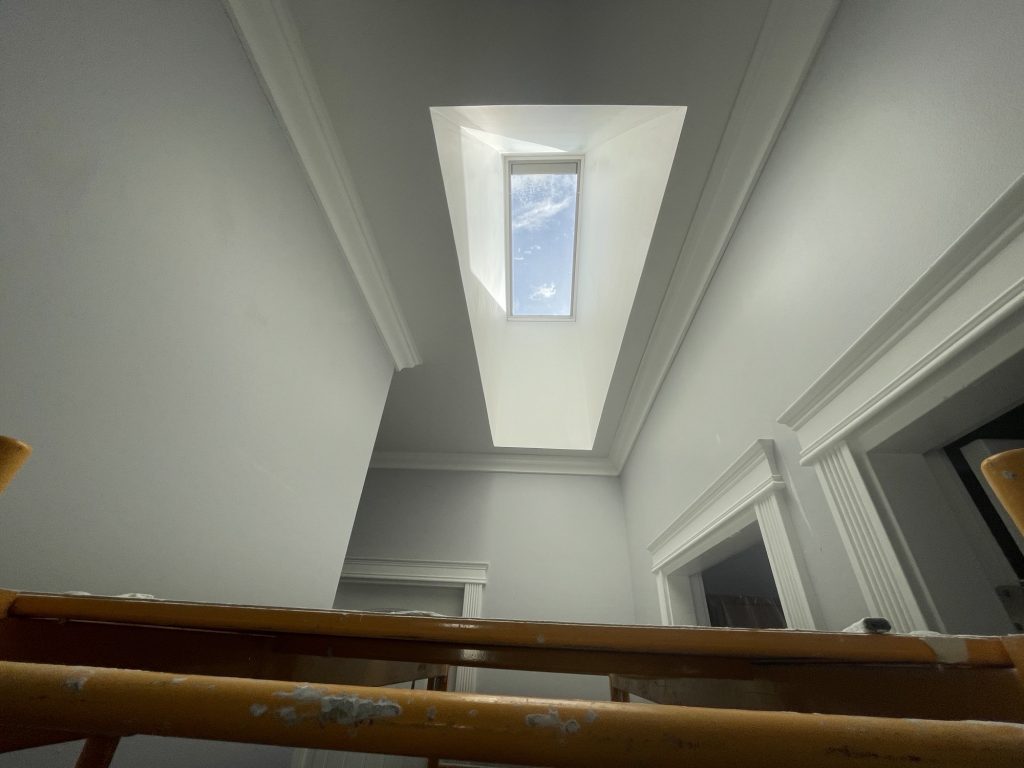
A ceiling repair that looks acceptable under flat construction lighting may become very visible once daylight or directional lighting crosses the finished surface.
That’s why both the structural repair and the final feathering matter.
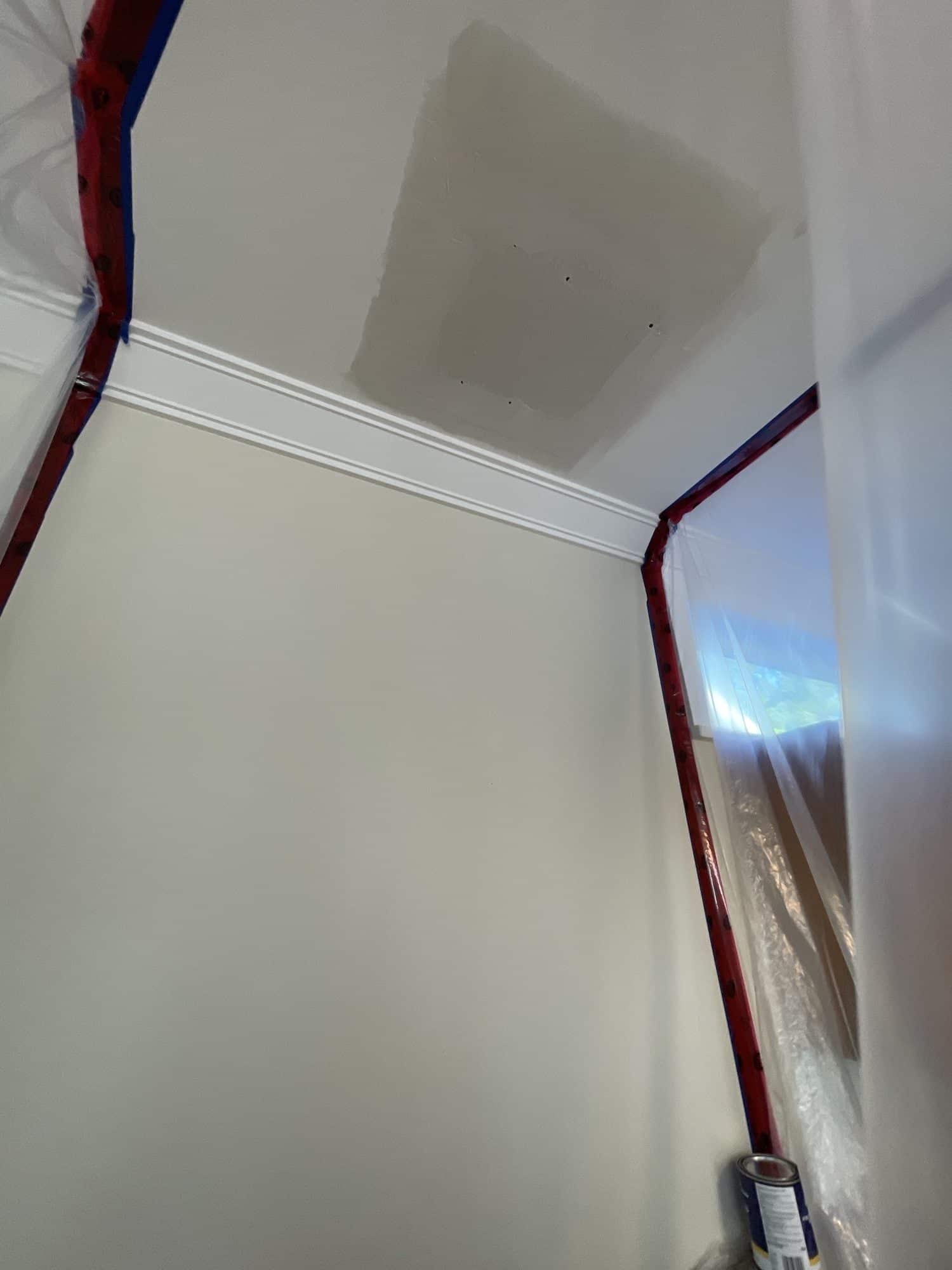
9. The Larger the Patch, the More Important the Transition Becomes
Homeowners often focus on the size of the actual opening.
Professional drywall finishers are usually thinking about something else:
How large does the finished repair need to become before the transition disappears?
A relatively small hole can require a much larger finished area.
Why?
Because the repair needs to gradually transition into the surrounding surface.
If the finishing is concentrated too tightly around the patch, the result can be:
- Visible humps
- Raised edges
- Depressions
- Texture differences
- Flashing after paint
- Repairs that become obvious under natural light
The goal isn’t simply to fill the opening.
The goal is to make the repair disappear into the existing surface.
What We Look at Before Repairing a Recurring Crack
A recurring drywall crack should be treated as part of a larger system.
Before determining the appropriate repair, we consider several factors.
Location of the Crack
Where the crack appears can tell us a great deal.
A crack above a doorway tells a different story than a crack following a long ceiling joint.
Direction and Shape
Straight cracks, diagonal cracks and irregular cracking patterns can point toward different conditions.
Previous Repairs
We look for evidence that the area has already been repaired and whether those repairs remain properly bonded.
Movement
Is the drywall secure?
Is the surrounding area moving?
Is there adequate support?
Moisture
Is there staining, softness or evidence that moisture may be contributing to the problem?
Material Transitions
Are we dealing with drywall-to-drywall, drywall-to-plaster, new-to-old construction or another transition?
Lighting
How will the repair actually look after paint?
Strong natural light and directional ceiling lighting can expose defects that are difficult to see during construction.
What Does a Proper Drywall Crack Repair Actually Involve?
There is no universal repair process for every crack.
Depending on the conditions present, a professional repair may involve:
- Inspecting the damaged area
- Determining whether the surrounding surface is stable
- Removing loose or failed material
- Adding backing or fastening where required
- Reinforcing the affected area
- Rebuilding the joint or damaged section
- Applying multiple finishing stages
- Feathering the repair into the surrounding surface
- Sanding and inspecting the finished area
- Preparing the surface for primer and paint
Some repairs require more.
Some require less.
That is exactly why a recurring crack shouldn’t automatically receive the same treatment every time.
The Final Test: Can You Still See the Repair?
A drywall repair can be technically sound and still look poor.
Finishing quality matters.
Common signs of inadequate drywall finishing include:
- Visible patch edges
- Raised joints
- Depressions
- Sanding scratches
- Surface texture differences
- Visible tape lines
- Flashing after paint
- Repairs visible under natural or directional light
At Finest Finish, the final appearance matters just as much as the work underneath.
The objective is simple:
Once the repair is painted, you shouldn’t immediately be able to identify where the damage used to be.
Why Some Drywall Repairs Cost More Than Others
Homeowners sometimes receive dramatically different prices for what appears to be the same drywall repair.
But the proposed scopes may not actually be comparable.
One repair may effectively be:
Fill → sand → paint
Another may involve:
Assess → open → stabilize → back → reinforce → finish → blend → inspect → prime
Those are fundamentally different approaches.
Finest Finish is not a production drywall company.
We provide a premium drywall service focused on long-term performance, finish quality and protection of the surrounding home.
Our approach includes:
- Journeyman boarders and finishers
- Proprietary installation and finishing systems refined over approximately 15 years
- Proper protection of surrounding surfaces
- Dust-control systems where appropriate
- Detailed finishing
- Thorough cleanup
- A lifetime warranty on qualifying work
We are rarely trying to be the cheapest drywall quote.
Our goal is to properly understand the problem, build the repair correctly and deliver a finished result worthy of the home around it.
Can a Drywall Crack Be Permanently Repaired?
Many recurring drywall cracks can be successfully addressed once the actual failure point is understood.
However, contractors need to be responsible when making promises.
A drywall contractor cannot control every future movement within a building.
If framing, structure or surrounding materials continue to move, the finished surface may eventually show evidence of that movement again.
The professional approach isn’t to claim that every crack in every building can never return.
It’s to:
Identify the probable cause, correct what can reasonably be corrected and use the appropriate repair system for the conditions present.
That’s an important distinction.
When Should a Homeowner Investigate Beyond the Drywall?
Most small drywall cracks are not automatically evidence of serious structural problems.
However, additional investigation should be considered when cracking is accompanied by:
- Rapidly widening cracks
- Significant ceiling sagging
- Several new cracks appearing together
- Doors or windows suddenly binding
- Noticeable changes in floors or ceilings
- Significant water intrusion
- Large displacement between surfaces
- Cracking that continues to worsen quickly
In these circumstances, drywall may simply be showing evidence of something occurring elsewhere in the building.
Understanding the underlying condition should come before cosmetic finishing, and homeowners should consult a qualified structural engineer or review BC Building Code standards if foundation or framing issues are suspected.
Drywall Crack Repair in Victoria, Saanich, Oak Bay & Fairfield
Finest Finish Painting & Drywall provides professional drywall repair and painting in Victoria, BC and throughout Greater Victoria.
We work on projects ranging from individual repairs to complete renovations and refinishing projects, including:
- Recurring drywall cracks
- Ceiling cracks
- Failed previous repairs
- Plumbing access repairs
- Electrical access repairs
- Water-damaged drywall
- Wall and ceiling repairs
- Drywall installation and finishing in Victoria, BC
- Renovation drywall
- Skim coating
- Ceiling refinishing
- Difficult transitions
- High-end finishing
Whether the repair is small or part of a major renovation, our philosophy remains the same:
Understand the problem. Prepare it properly. Build the repair correctly. Finish it so it disappears.
Frequently Asked Questions About Recurring Drywall Cracks
Why Does My Drywall Crack Keep Coming Back in Exactly the Same Place?
Usually because the same movement or weak point remains underneath the finished surface. Failed tape, insufficient support, movement or an incomplete previous repair are common possibilities.
Can You Just Put More Drywall Compound Over a Crack?
Sometimes a minor cosmetic crack can be repaired simply. A crack that repeatedly returns deserves more investigation because additional compound alone may not address the underlying cause.
Why Do Cracks Commonly Appear Above Doors?
Doors and windows interrupt the wall assembly and create areas where movement can become concentrated. Their corners are therefore common locations for visible cracking.
Are Drywall Ceiling Cracks Normal?
Some ceiling cracking is associated with drywall joints or ordinary building movement. Cracking accompanied by significant sagging, moisture, displacement or rapid changes should be investigated before cosmetic repair.
Why Can I See My Drywall Patch After Painting?
The repair may not have been feathered widely enough, the texture may differ from the surrounding surface, sanding scratches may remain, or differences in surface porosity may show through the paint.
Can Old Plaster Walls Be Repaired Alongside Drywall?
Often, yes. Plaster and drywall behave differently, however, so the existing substrate and condition of the surrounding materials should be assessed before choosing the repair method.
Do You Repair Small Drywall Cracks or Only Large Renovation Projects?
Both.
Finest Finish works on drywall projects of many sizes—from individual repairs and ceiling issues to substantial renovations and complete drywall installation and finishing projects.
Have a Drywall Crack That Keeps Coming Back?
If the same crack has already been repaired once—or several times—it may be time to look beyond the surface.
Finest Finish Painting & Drywall provides premium drywall repair throughout Victoria, Saanich, Oak Bay, Fairfield and surrounding communities.
Our journeyman team can assess the damaged area, determine the appropriate repair approach and rebuild the surface using the same standards we apply to our larger renovation work.
Request a detailed drywall repair estimate.
Finest Finish Painting & Drywall
Victoria, BC
250-686-9483
finestfinish.ca